
Why Pack Rats Are Invading Leeds, UT Homes as Desert Temperatures Climb
Why Pack Rats Are Invading Leeds, UT Homes as Desert Temperatures Climb
Leeds, UT sits where red rock, juniper, and sagebrush meet a small grid of homes — exactly the kind of edge habitat pack rats look for. As desert temperatures climb through May and into summer, the local woodrat population shifts closer to houses, garages, and outbuildings in search of shaded shelter and nesting material. A rodent well-adapted to the desert finds suburban Leeds easier to live in than the open canyon floor.
If you're seeing droppings in the garage, hearing scratching in the attic at dusk, or finding strange piles of twigs and shiny objects tucked behind a tire or under a generator, you're likely dealing with pack rats. For homeowners weighing options for rodent control in Leeds, UT, this guide walks through what makes pack rats different from mice or roof rats, why summer drives them indoors, the damage they cause, the health risks worth understanding, and how our team at Novix Pest Control handles them on southern Utah properties.
Meet the Pack Rat: Southern Utah's Most Common Rodent
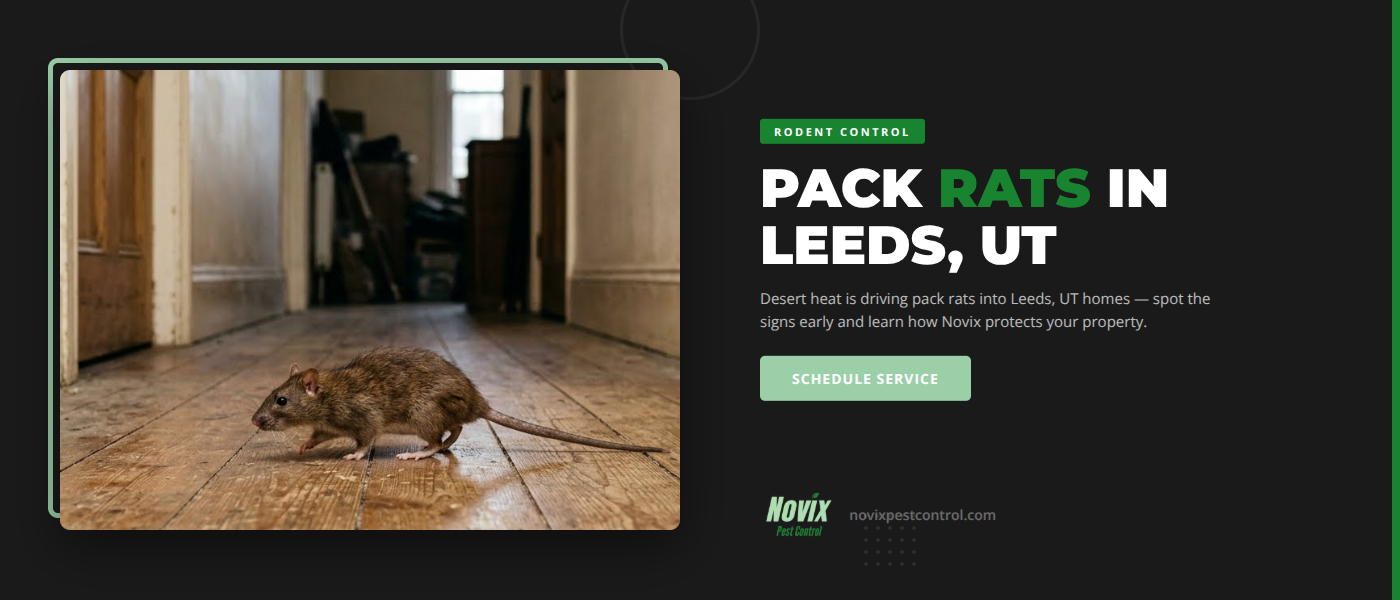
Pack rats — also called woodrats or trade rats — are the dominant rodent across the red-rock country around Leeds. The white-throated woodrat (Neotoma albigula) and bushy-tailed woodrat (Neotoma cinerea) are the two species local homeowners encounter most often. Larger than a deer mouse, with a softball-sized body, prominent eyes, and large ears, they're native to the desert Southwest and don't depend on human food waste.
What makes them so noticeable is their hoarding. A pack rat will haul almost anything back to its nest — cholla joints, juniper twigs, bones, bottle caps, jewelry, even small tools. The nest itself, called a midden, is a fortress of stacked debris that can sit in one spot for decades.
Why Leeds Homes See More Rodent Activity as Summer Heat Builds
Pack rats don't hibernate, but their activity shifts sharply with temperature. Through cool months they range widely, foraging on cactus and mesquite pods. Once daytime highs in Leeds push past the mid-90s and overnight lows stay above 65, the calculation changes. Open desert is hot, dry, and exposed; a Leeds garage, crawl space, or attic is shaded, structurally protected, and often cooler by 15 to 20 degrees.
A few specific factors push more pack rats toward Leeds homes each summer:
- Drip irrigation and ornamental landscaping: Watered planting beds give pack rats both water and a supply of nesting material.
- Outbuildings and storage: Sheds, RV covers, and detached garages create the dim, undisturbed habitat woodrats prefer.
- Vehicles parked for the season: Trailers, side-by-sides, classic cars, and campers become prime nesting real estate — tire wells offer cover and engine bays hold heat overnight.
- Open desert at the property line: Many Leeds parcels back directly onto BLM ground or undeveloped lots, so woodrats already living in the surrounding rocks only need to cross a fence to reach the house.
That's why rodent control in Leeds, UT calls cluster between May and September, with a smaller wave around the first cold snap in October.
Warning Signs of a Pack Rat Infestation in Your Property
Pack rats are quieter than mice but leave heavier evidence. Walking the property and trusting your eyes, ears, and nose catches most infestations early — and early intervention is far less involved than removing a midden that's been building for years.
- Droppings: About half an inch long, dark, and oblong — much larger than mouse droppings. Look in clusters along beams, garage corners, on top of stored boxes, or near entry points.
- Middens: The signature tell. Piles of twigs, cactus joints, leaves, paper, and shiny objects tucked into a sheltered nook — under a workbench, behind a water heater, in the bed of a stored trailer.
- Greasy rub marks: Dark smears from fur oil along walls and beams where rats follow consistent travel paths.
- Gnaw marks: Fresh chewing on framing, wire insulation, plastic conduit, irrigation lines, and stored cardboard.
- Sound: Scratching, scurrying, or thumping in the attic or walls — usually starting around dusk.
- Smell: An established midden produces a strong, musky odor from accumulated urine, often the first thing you notice opening the garage.
If two or three of these signs cluster in the same area, there's an active nest within roughly 30 feet — almost always closer than homeowners expect.
The Damage Pack Rats Cause to Wiring, Vehicles, and Insulation
Pack rats earn their reputation as the costliest rodent in the desert Southwest. Their incisors grow continuously, so they gnaw constantly to wear them down. In a Leeds garage or attic, that means electrical wiring, insulation, and the wiring harness in your stored RV are all fair game.
- Vehicle wiring: Modern automotive wire insulation contains soy-based materials pack rats find palatable. Engine-bay damage on stored trucks, RVs, and side-by-sides routinely runs into the thousands to repair.
- Home electrical and HVAC: Chewed wiring inside walls and attics is a structural and fire concern. Rodents commonly take out low-voltage thermostat wires, doorbell wires, and HVAC control wiring.
- Insulation: Blown-in attic insulation gets matted, soiled, and tunneled through, dropping R-value and pushing summer cooling costs up.
- Irrigation: Drip lines and PVC fittings get chewed and dragged into nests, causing slow leaks that aren't discovered until the next pressure test.
- Stored items and framing: Cardboard, fabric, paper records, and softer wood all get chewed for nest material.
Insurance coverage for rodent-caused damage is inconsistent, and a chewed wiring loom can fall outside vehicle comprehensive coverage entirely. The math almost always favors prevention over repair.
Health Concerns: Hantavirus and Other Rodent-Borne Risks in Utah
The serious health concern with desert rodents in Utah is hantavirus pulmonary syndrome (HPS). Per the Centers for Disease Control and Prevention, the deer mouse is the primary reservoir in the western United States, and HPS cases concentrate in the Four Corners region. People most often contract the virus by inhaling dust contaminated with rodent urine, droppings, or saliva, which is why sweeping or vacuuming a contaminated space is exactly what public-health agencies advise against.
Pack rats themselves are not the primary hantavirus carriers, but pack-rat infestations almost always coincide with deer mice using the same shelter, so the practical risk to a Leeds homeowner with rats in the garage is real. Beyond hantavirus, pack rats can carry plague (still present in Utah's wildlife), tularemia, and ectoparasites — fleas and ticks that travel with the host into your home.
Cleanup of an active midden should follow CDC protocol: ventilate the space, wet down droppings with disinfectant before any disturbance, wear gloves and an N95-rated respirator, and double-bag everything. We handle that cleanup as part of every removal — and it's one of the strongest reasons not to DIY a pack-rat midden in a closed garage.
How Novix Removes Pack Rats and Seals Your Home for Good
A pack-rat job done right is not a quick spray or a handful of snap traps tossed in the corner. Pack rats are intelligent, neophobic (suspicious of new objects in their territory), and capable of returning to a cleared midden within days if the structural conditions that drew them in haven't changed. Our approach at Novix runs in three phases:
- Inspection and mapping: We walk the full property — interior, exterior, attic, crawl space, garage, outbuildings, and vehicles — to locate active middens, identify travel routes, and find every entry point. Pack rats can squeeze through a gap the size of a quarter, so inspection is detailed.
- Targeted removal: Snap traps and bait stations placed along confirmed travel routes, secured against pets, children, and non-target wildlife. Middens are cleaned out under CDC-aligned protocol; contaminated insulation is removed and replaced.
- Exclusion and structural sealing: Where most DIY jobs fall short. We seal entry points with hardware cloth, copper mesh, sheet metal, and structurally appropriate sealants — materials pack rats can't chew through. Vents are screened, garage door sweeps replaced or upgraded, and utility penetrations closed off.
Once the structure is sealed, we schedule follow-up visits to confirm activity has stopped and refresh exterior monitoring stations. Our team holds a 4.8-star reputation across Leeds, St. George, Washington, Ivins, and the rest of Washington County because we treat pack rats the way southern Utah actually produces them — methodically, with exclusion as the heart of the job.
Prevention Tips for Leeds Homeowners All Year Long
The most reliable way to handle pack rats is to make your property a poor candidate before any infestation starts. None of these are exotic, but consistency matters more than any single step.
- Remove harborage: Stacked firewood, scrap lumber, old tires, and unused equipment piled against the house are pack-rat magnets. Move wood piles at least 20 feet from structures and elevate them off the ground.
- Trim back vegetation: Keep tree limbs, ornamental shrubs, and prickly pear at least three feet from exterior walls. Pack rats use overgrowth as cover and climbing routes onto roofs.
- Seal openings: Walk the foundation, garage door seals, dryer vents, attic vents, and roof penetrations annually. Anything bigger than a quarter is a potential entry.
- Manage the garage and shed: Store cardboard in sealed bins, elevate stored items off the floor, and leave 18 inches of clearance from walls so new activity is visible.
- Protect stored vehicles: Tape off engine air intakes on long-term storage, place rodent-deterrent stations in tire wells, and start engines periodically through the off-season.
- Address water sources: Leaking irrigation, dripping hose bibs, and pet water bowls left out overnight all reduce the pressure that would otherwise push rats off the property.
- Schedule a spring perimeter inspection: Catching the seasonal shift before pack rats settle in is the single most cost-effective prevention step.
Frequently Asked Questions About Rodent Control in Leeds, UT
How can I tell if I have pack rats versus regular rats or mice?
The clearest tell is the midden — pack rats build elaborate nests packed with twigs, cactus joints, and collected debris, often with shiny objects mixed in. Their droppings are about half an inch (much larger than mouse droppings), and the rats themselves are heavy-bodied with prominent eyes and ears. Norway rats and roof rats are slimmer and don't hoard.
Why are pack rats worse in summer in Leeds?
Daytime temperatures in Leeds push past 100°F by midsummer, and pack rats — though desert-adapted — still seek shaded shelter. Garages, attics, sheds, and stored vehicles run cooler than open desert. Summer also brings juvenile rats dispersing from established middens, which is when most homeowners notice activity for the first time.
Are pack rats a hantavirus risk?
Pack rats themselves aren't the primary hantavirus reservoir — that's the deer mouse — but pack-rat middens commonly shelter deer mice, so the practical risk in an active infestation is real. Cleanup should follow CDC guidance: ventilate the area, wet droppings with disinfectant before disturbing them, wear an N95 respirator, and avoid sweeping or vacuuming dry material.
How long does professional pack-rat removal take?
For a typical Leeds property with one or two middens, the initial removal and exclusion work takes a single visit, with follow-up checks across the next two to four weeks. Larger properties with multiple outbuildings or long-established middens may run a phased program over six to eight weeks.
Get Ahead of Pack-Rat Season in Leeds, UT
Pack rats are part of the southern Utah landscape — but they don't have to be in your garage, your attic, or your stored RV. Properties that stay clear of serious infestations treat structural sealing, exterior management, and seasonal monitoring as a quiet background program rather than a reaction to chewed wiring or a midden behind the water heater.
Novix Pest Control brings deep local experience to rodent control in Leeds, UT. We know the pack-rat behavior, where they nest on Washington County properties, and how to seal a home so they stay outside where they belong. If you're seeing the signs — droppings, scratching, the musky odor in the garage — reach out and our team will put together a plan tailored to your property.


